Timezone in Colorado: Your Complete Guide to Mountain Time, DST & Time Differences
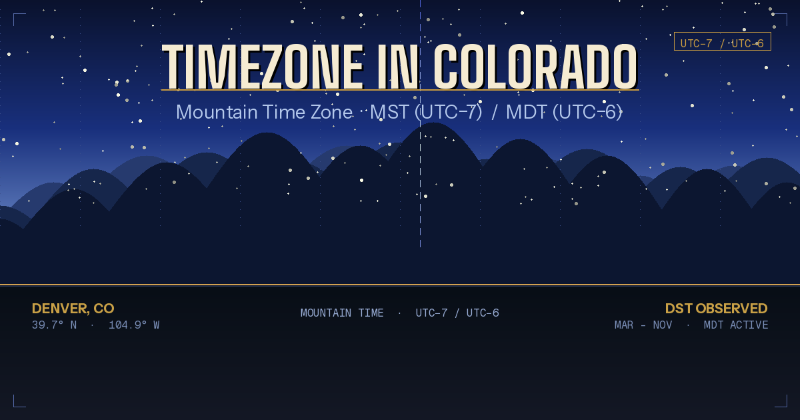
If you've ever tried to schedule a meeting across states, catch a live sports broadcast, or figure out when to call a friend in Colorado, you've probably asked: what timezone is Colorado in? The answer is straightforward, but the details — Daylight Saving Time shifts, comparisons with neighboring states, and tips for remote workers — matter a great deal in everyday life. This guide covers everything you need to know about the timezone in Colorado, written in plain language so you can act on it immediately.
What Timezone Is Colorado In?
Colorado is located entirely within the Mountain Time Zone — one of the six time zones used across the contiguous United States. This means the entire state, from Denver in the northeast to Durango in the southwest, operates on the same clock. You never have to worry about crossing an internal time boundary as you drive through the state.
The Mountain Time Zone has two official designations depending on the season:
- Mountain Standard Time (MST) — observed from early November through mid-March, UTC−7.
- Mountain Daylight Time (MDT) — observed from mid-March through early November, UTC−6.
Quick answer: Colorado is on Mountain Standard Time (MST, UTC−7) in winter and Mountain Daylight Time (MDT, UTC−6) in summer. If someone simply asks "what time zone is Colorado?", the safe answer year-round is Mountain Time (MT).
Mountain Standard Time vs. Mountain Daylight Time in Colorado
Understanding the difference between MST and MDT is important for anyone communicating across time zones or setting automated reminders. Here's a clear breakdown:
| Designation | Full Name | UTC Offset | Active Period | Example |
|---|---|---|---|---|
| MST | Mountain Standard Time | UTC−7 | 1st Sun of Nov → 2nd Sun of Mar | When it's noon UTC, it's 5:00 AM in Colorado |
| MDT | Mountain Daylight Time | UTC−6 | 2nd Sun of Mar → 1st Sun of Nov | When it's noon UTC, it's 6:00 AM in Colorado |
The transition happens automatically for most digital devices. In 2026, Colorado clocks spring forward on March 8 at 2:00 AM (clocks move to 3:00 AM) and fall back on November 1 at 2:00 AM (clocks move to 1:00 AM).
Daylight Saving Time (DST) in Colorado
Colorado observes Daylight Saving Time (DST) in accordance with federal law under the Uniform Time Act of 1966. Every spring, clocks move forward one hour — giving residents an extra hour of evening sunlight but shortening the morning. Every autumn, they fall back.
Key DST Dates for Colorado (2025–2026)
| Year | Spring Forward (MST → MDT) | Fall Back (MDT → MST) |
|---|---|---|
| 2025 | March 9, 2025 at 2:00 AM | November 2, 2025 at 2:00 AM |
| 2026 | March 8, 2026 at 2:00 AM | November 1, 2026 at 2:00 AM |
Traveler's tip: If you're flying into Denver International Airport (DEN) around a DST transition weekend, always double-check your flight and hotel confirmation times — your home state may have already changed clocks while Colorado hasn't, or vice versa.
Pros and Cons of Colorado Being on Mountain Time
Every time zone has its advantages and trade-offs. Here's an honest look at what Mountain Time means for life in Colorado:
✅ Pros of Mountain Time
- Long summer evenings — sunsets after 8:30 PM in June make outdoor life spectacular.
- Sports on a reasonable schedule — NFL Sunday Night Football starts at 6:20 PM instead of 8:20 PM.
- Good overlap with both coasts for remote work — 9 AM ET is 7 AM MT.
- Earlier prime-time TV compared to the West Coast.
- Mild sunrise times in summer, great for early hikers and trail runners.
- One-hour buffer before the East Coast workday, useful for morning preparation.
❌ Cons of Mountain Time
- Late-night East Coast TV events (award shows, debates) end past midnight MT.
- Financial markets open at 7:30 AM MT — tough for traders who aren't morning people.
- Conference calls with West Coast can mean early starts (6–7 AM MT).
- International calls to Europe require very early mornings (London is 6–7 hours ahead).
- DST transitions still disrupt sleep schedules twice a year.
- Short winter days feel even shorter with limited afternoon daylight.
Colorado Time Zone vs. Other US Time Zones: Complete Comparison
Planning a call or visit to or from Colorado? This comprehensive table shows exactly how Colorado's Mountain Time compares to every major US time zone, in both standard and daylight periods:
| Time Zone | States (Examples) | Difference from Colorado (MST) | Difference from Colorado (MDT) |
|---|---|---|---|
| Eastern (ET) | New York, Florida, Georgia | +2 hours ahead | +2 hours ahead |
| Central (CT) | Texas, Illinois, Minnesota | +1 hour ahead | +1 hour ahead |
| Mountain (MT) | Colorado, Wyoming, Montana | Same | Same |
| Pacific (PT) | California, Oregon, Washington | −1 hour behind | −1 hour behind |
| Alaska (AKT) | Alaska | −2 hours behind | −2 hours behind |
| Hawaii (HST) | Hawaii | −3 hours behind (no DST) | −4 hours behind |
| Arizona (MST, no DST) | Arizona (most of state) | Same as CO in winter | −1 hour behind CO in summer |
Colorado vs. Arizona: A Special Case to Know
One of the most confusing timezone scenarios in the American West is the Colorado–Arizona relationship. Both states sit in the Mountain Time Zone, but Arizona does not observe Daylight Saving Time (with the exception of the Navajo Nation). This creates a seasonal twist:
- In winter (MST), Colorado and Arizona are on the same time.
- In summer (MDT), Colorado is one hour ahead of most of Arizona.
- If you're traveling from Denver to Phoenix in July, you effectively gain an hour when you land.
- The Navajo Nation (northeastern Arizona) does observe DST, creating a patchwork effect for drivers crossing the Four Corners region.
Colorado Time Zone for Remote Workers and Digital Nomads
Colorado has become one of the most popular states for remote workers and digital nomads — and its Mountain Time Zone plays a surprisingly big role in that appeal. Here's how the timezone in Colorado affects distributed teams:
Working with East Coast Colleagues
Colorado is two hours behind New York and Washington D.C. This means a standard 9 AM ET standup becomes a 7 AM MT meeting for Colorado-based workers. While that's early, it does free up the entire afternoon for focused work without meeting interruptions. Many remote workers in Colorado actually appreciate this rhythm.
Working with West Coast Colleagues
Colorado is one hour ahead of California, Oregon, and Washington state. A 9 AM PT start is 10 AM MT — perfectly comfortable. This gives Colorado workers a natural one-hour head start on the Pacific coast workday, which can be a meaningful productivity advantage.
International Coordination from Colorado
| City / Region | Time Difference from Colorado (MDT, Summer) | Best Call Window (Colorado local) |
|---|---|---|
| London, UK (BST) | +6 hours | 7:00 AM – 11:00 AM MT |
| Paris / Berlin (CEST) | +7 hours | 7:00 AM – 10:00 AM MT |
| Mumbai, India (IST) | +11.5 hours | 6:00 AM – 9:00 AM MT |
| Tokyo, Japan (JST) | +15 hours | Best by async / early morning |
| Sydney, Australia (AEST) | +16 hours | Best by async / early morning |
| Mexico City (CST/CDT) | Same or +1 hour (varies by DST) | Anytime business hours |
Neighboring States and Their Time Zones
Colorado shares borders with seven states. Understanding how their time zones relate to Colorado helps immensely when planning road trips, border town appointments, or cross-state business.
- Wyoming (MT) — Same timezone as Colorado. No adjustment needed.
- Nebraska (CT) — One hour ahead of Colorado. The western panhandle of Nebraska is sometimes a point of confusion for travelers.
- Kansas (CT) — One hour ahead of Colorado. Note that the extreme western tip of Kansas uses MT informally in some communities.
- Oklahoma (CT) — One hour ahead of Colorado.
- New Mexico (MT) — Same timezone as Colorado. No adjustment needed.
- Arizona (MST, no DST) — Same in winter, one hour behind Colorado in summer (see above).
- Utah (MT) — Same timezone as Colorado. No adjustment needed.
How to Always Know the Current Time in Colorado
Whether you're a traveler, a remote team manager, or just curious, here are the most reliable ways to check the current time in Colorado at any moment:
- Google Search — Simply search "current time in Denver, Colorado" and Google instantly displays the local time with the timezone label.
- World Time Server (worldtimeserver.com) — A dedicated site for precise timezone lookups worldwide.
- Time.is — Shows real-time clock for any city with millisecond precision and UTC offset information.
- Smartphone Clock App — Add "Denver, CO" as a secondary clock face in iOS (Clock → World Clock) or Android's Clock app.
- Google Calendar — Automatically converts event times when you set your timezone to Mountain Time.
- Zoom / Microsoft Teams — When scheduling a meeting, both platforms show participant local times automatically based on account timezone settings.
Tips for Travelers Visiting Colorado
If you're flying, driving, or otherwise visiting Colorado from another time zone, a few small adjustments can make your trip smoother:
Before You Arrive
- Adjust your watch and devices to Mountain Time as soon as you board your flight — your body will adapt faster.
- Book sunrise activities (Rocky Mountain National Park, popular trail starts) using Mountain Time, not your home time.
- Confirm all reservations — restaurants, hotels, tour guides — and verbally confirm they are quoting Mountain Time.
During Your Stay
- Sunset in Denver during summer (MDT) happens after 8:15 PM — plan evening hikes and outdoor dining accordingly.
- Altitude combined with jet lag can amplify fatigue; go to bed at local Mountain Time, not when your body "feels" like sleeping.
- Colorado sports teams (Denver Nuggets, Broncos, Avalanche, Rockies) play on Mountain Time — great for evening games if you're used to the East Coast.
Pro tip for photographers: Golden hour in Colorado during summer (MDT) falls roughly 8:00–8:45 PM — among the latest in the contiguous US. Plan your landscape shots accordingly for that stunning Rocky Mountain light.
Does Colorado Ever Consider Leaving Mountain Time?
Like many states, Colorado has seen periodic legislative discussions about eliminating the twice-yearly Daylight Saving Time clock change. Several bills have been proposed in the Colorado General Assembly to either stay on permanent MST (Standard Time) or permanent MDT (Daylight Time), mirroring similar movements in California (Prop 7), Washington, and Florida (the Sunshine Protection Act at the federal level).
As of early 2026, Colorado still observes both MST and MDT with the standard federal schedule. Any permanent change would require federal authorization under the Uniform Time Act — something that has not yet been granted. Residents and businesses should continue planning for the twice-yearly clock change until federal law changes.
Frequently Asked Questions About the Timezone in Colorado
Q: What timezone is Colorado in right now?
Colorado is in the Mountain Time Zone. From the second Sunday of March through the first Sunday of November, Colorado observes Mountain Daylight Time (MDT, UTC−6). The rest of the year, it observes Mountain Standard Time (MST, UTC−7).
Q: Is Colorado in MST or MDT?
It depends on the season. Colorado is on MST (UTC−7) in winter (roughly November through March) and on MDT (UTC−6) in summer (roughly March through November). The common shorthand is simply "Mountain Time" or "MT" to cover both.
Q: How many hours behind is Colorado from New York?
Colorado is 2 hours behind New York (Eastern Time) for most of the year. Both states observe Daylight Saving Time, so the 2-hour gap stays constant year-round. When it's noon in New York, it's 10:00 AM in Denver.
Q: Is Denver, Colorado on Mountain Time?
Yes. Denver, the state capital, is firmly in the Mountain Time Zone. All major Colorado cities — Denver, Colorado Springs, Aurora, Fort Collins, Boulder, and Pueblo — are on Mountain Time.
Q: Does Colorado observe Daylight Saving Time?
Yes. Colorado observes Daylight Saving Time (DST) by moving clocks forward one hour in spring ("spring forward") and back one hour in fall ("fall back"). This follows the standard US federal schedule under the Uniform Time Act.
Q: What is the difference between Colorado time and California time?
Colorado (Mountain Time) is 1 hour ahead of California (Pacific Time). Both observe DST, so this gap stays constant throughout the year. When it's 9 AM in Los Angeles, it's 10 AM in Denver.
Q: Is Colorado time the same as Utah or New Mexico time?
Yes — both Utah and New Mexico are in the Mountain Time Zone and also observe Daylight Saving Time, so they are always on the same time as Colorado. There is no time difference when traveling between these states.
Q: When does Colorado change its clocks in 2026?
In 2026, Colorado clocks spring forward on March 8 at 2:00 AM (clocks jump to 3:00 AM, MST → MDT) and fall back on November 1 at 2:00 AM (clocks drop to 1:00 AM, MDT → MST).
Q: What is Colorado time compared to GMT/UTC?
Colorado is UTC−7 during Mountain Standard Time (winter) and UTC−6 during Mountain Daylight Time (summer). So if it's 12:00 UTC (noon in London on GMT), it is 5:00 AM MST or 6:00 AM MDT in Colorado.